


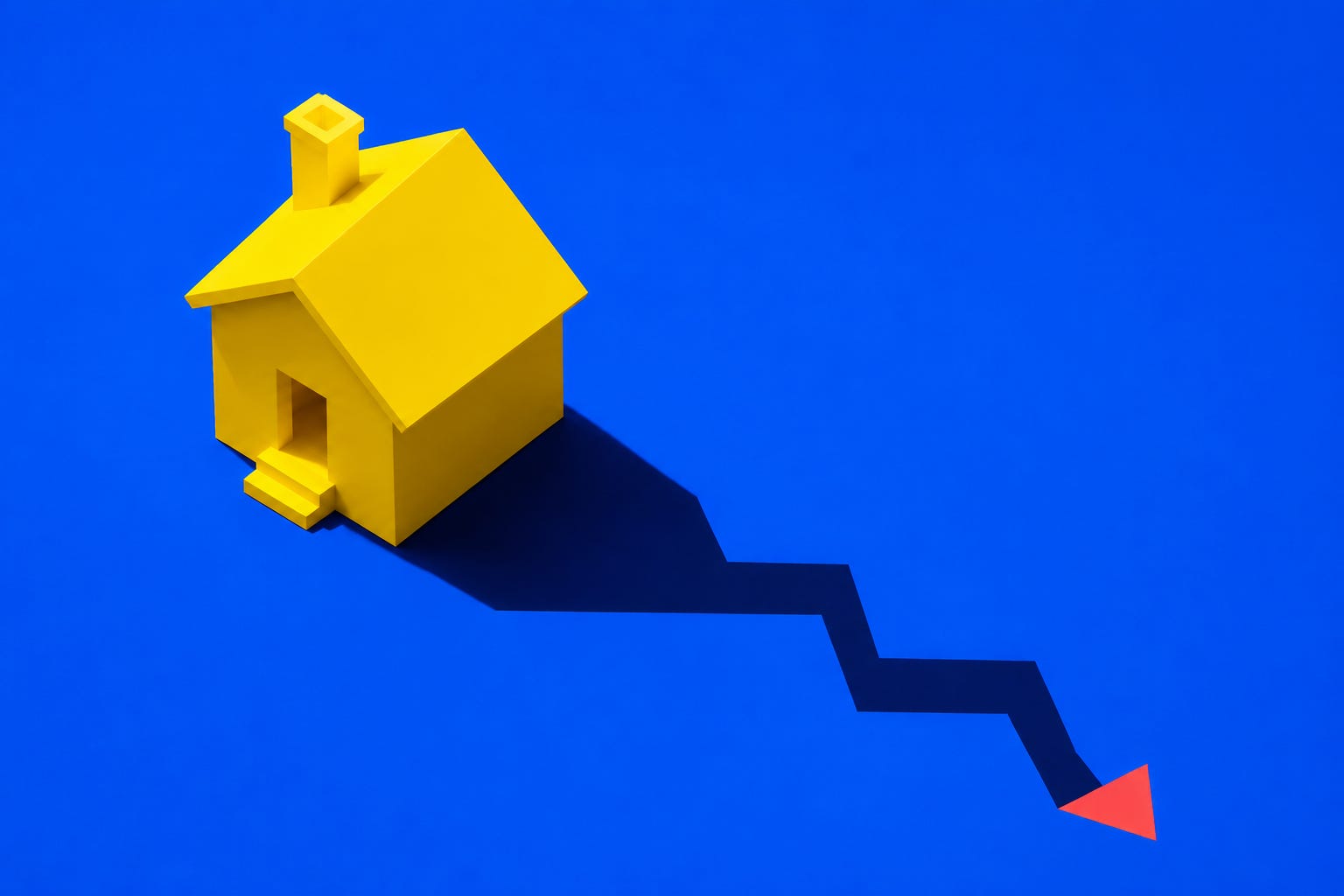
Toronto house prices peaked in 1989. They fell 28.5%. Adjusted for inflation, they did not get back to that peak until 2011.
Twenty-two years.
I think about that number a lot, because almost nobody I talk to knows it. The story Canadians tell each other about real estate has no room in it for a twenty-two year round trip.
I was at a Blue Jays game in June with friends, and one of them — he’s been trying to buy in Toronto for a while now — described a market where nothing happens. Sellers anchored to 2022 prices. Buyers unwilling to meet them. The only deals closing are the ones where somebody got impatient.
And around that table, more than one person still said some version of well, you can’t really lose money on property.
You can. The average Greater Toronto home price was $1,334,544 in February 2022. In February 2026 it was $1,008,968. That’s about 24% gone in four years. Toronto condos have had it worse on a per-square-foot basis, and there are roughly 92 months of unsold new inventory sitting behind that number, which is not a supply picture that resolves quickly.
None of which makes real estate a bad investment. I own a five-unit building in Nova Scotia. I’m not writing this to talk anyone out of anything.
I’m writing it because the belief that property is safe quietly removes the only question that matters.
What real estate actually is
It’s a medium-risk asset. Not a safe one, not a wild one.
That framing does real work, because it sets the return you’d want before committing capital. Nobody demands a premium from an asset they’ve decided is risk-free. They just buy it and hope.
There are three honest reasons to own property, and they’re not equally strong.
You can raise the income yourself. This is the best one. A building is an operating business. Renovate and re-lease higher, bring below-market rents toward market, re-tender the insurance, fix the thing that’s bleeding money. Every dollar you add to net operating income lifts your cash flow and the asset’s value at the same time. That lever does not exist inside an index fund, and it’s the reason experienced operators keep buying while everyone else is frozen.
Leverage can multiply the return. There’s a condition attached, and it’s the subject of next week’s brief, because most people get the test wrong.
You can see it. You know the street, the tenant, the contractor. For a lot of investors that makes the asset far easier to hold through a bad stretch — and holding through bad stretches is where most investment returns are actually won. It’s a real benefit. It is not a return, and it shouldn’t be carrying much weight in the decision.
The part that gets left out
Work. Unglamorous, unscheduled, constant.
Something breaks whenever it feels like it. A tenant leaves and the unit needs paint, cleaning, photos, showings and screening before it earns again. There are vendors to line up, inspections to document, provincial tenancy paperwork to keep current. Either you build a network of trades you trust, or you learn to do a surprising amount yourself. Hand it to a property manager and the fee comes straight out of the return you were counting on.
Now hold that against the alternative. You buy a broad-market fund. You do nothing. It compounds. Nobody calls you at 11pm about a furnace.
That gap in effort is the single most underestimated variable in the comparison, and where the returns land close together, it is doing all of the work.
The question underneath
So the question was never is real estate a good investment.
It’s: what hurdle rate does this have to clear before it beats doing nothing?
Answering that requires knowing what properties actually yield, what your financing genuinely costs, and where the line sits for you. That’s next Tuesday — including the number most buyers never calculate, and why leverage at today’s rates can quietly work against you.
The full version, with the Halifax numbers and every source: https://www.yougotthiswealth.com/blog/real-estate-vs-stocks-canada/?utm_source=substack&utm_medium=email&utm_campaign=brief_2026_08_26&utm_content=canonical
Sources: Toronto Regional Real Estate Board; Urbanation Q1 2026.
If you’d rather see what a decision like this does to your own numbers instead of a hypothetical one, that’s the thing I’ve been building — https://app.yougotthiswealth.com/auth?utm_source=substack&utm_medium=email&utm_campaign=brief_2026_08_26&utm_content=soft_cta