



I try not to fixate on what other people have. But it’s normal to feel the grass is greener sometimes, or feel that old “keeping up with the Joneses” pull, and today it’s probably stronger than ever. The bar for “doing well” has drifted somewhere unrecognizable. A garage and a second bathroom used to mean you’d made it. Now it can feel like unless you’ve founded a tech unicorn, you’re behind. Even people with MBAs and great jobs can’t buy a house in half the markets in the country.
So how do you actually measure where you stand? The usual answer is net worth. It’s worth understanding what that number is really telling you, and what it quietly hides.
First, the benchmark. Statistics Canada’s most recent Survey of Financial Security (2023) puts the median net worth of a household in its late thirties to early forties at $409,300, climbing with age from there:
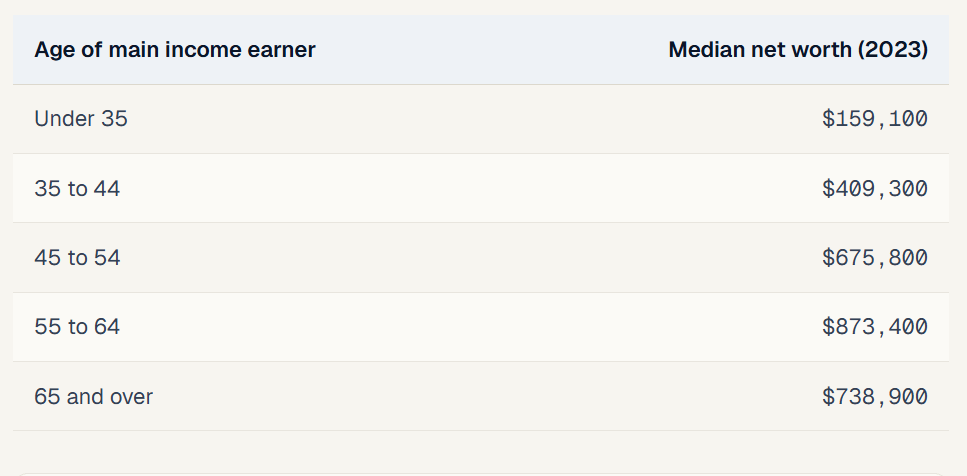
Source: Statistics Canada, Survey of Financial Security, 2023. Median net worth, families grouped by age of major income recipient, constant 2023 dollars. Overall median across all Canadian households: $519,700. These are the latest available figures — the next Survey of Financial Security cycle is expected in early 2027.
One thing before you measure yourself against it: use the median, not the average. The average is always higher, because a handful of very wealthy families drag the mean upward. If you’ve ever seen an “average net worth” figure and felt behind, you were probably comparing yourself to a number inflated by the richest few per cent.
Here’s the part nobody talks about. Your net worth is one number, but it’s built from dollars that behave nothing alike. The arithmetic treats them as identical. Real life doesn’t.
A dollar in your TFSA is the only truly clean dollar you own. It’s already taxed, grows tax-free, comes out whenever you want, in full. It’s the one line where the number on the screen is the number you keep.
A dollar in your RRSP is a dollar you co-own with the CRA. You got a deduction going in, it grows untaxed, and every dollar comes out taxed as income. So a $500,000 RRSP is not $500,000 of spendable money. That’s a meaningful slice belongs to a silent partner who collects at the end.
And a dollar of home equity is real wealth you can’t actually spend without selling the roof over your head or borrowing against it.
Which raises the question I find most interesting: should your home even count?
Most people include it (it has value, you own it). The financial-independence crowd excludes it (you can’t eat a house). But there’s a third view worth sitting with: a home behaves a lot like a liability. It’s illiquid. You never really liberate the money, because you always need somewhere to live. Functionally, it’s an inheritance your kids will one day realize, not money you’ll ever spend. And even fully paid off, it runs a negative cash flow every year: tax, insurance and maintenance. An asset that costs you money to hold and that you can never spend is doing a pretty good impression of a liability.
(For what it’s worth: in our app, your home is in your net worth at full value but out of your retirement projections. It’s part of the honest snapshot of what you own - but you can’t draw 4% a year from a kitchen.)
Put it together with two households, each at exactly $800,000.
Household A holds it as TFSA, non-registered investments, cash, and modest home equity. Most of it is accessible and lightly taxed. If life demanded it, they could put their hands on most of it quickly.
Household B holds $400,000 in an RRSP, $350,000 in home equity, and $50,000 in cash. Same headline number. But the RRSP is taxed on the way out, the home equity can’t be touched without selling, and the genuinely liquid, already-theirs figure is the $50,000.
Same number. Completely different lives. One has options this year; the other has a strong balance sheet they mostly can’t reach. A net worth comparison would rank them identically. This is exactly why the single number, on its own, tells you so little.
None of this means your number is wrong. The gross figure is the honest starting point. But a snapshot isn’t the same as understanding it. The number only becomes useful the moment you can see what it’s actually made of: how much is liquid, how much the CRA still has a claim on, how much is just keeping a roof over your head.
The full breakdown - every line on the balance sheet, read for what kind of dollar it really is (including the corporate account, the pension you have to go looking for, and the education fund that was never really yours) - is on the site:
Or if you’d rather just see your own number broken down this way, you can do that here.
If someone forwarded you this, subscribe to The YouGotThis Brief — clear, Canadian, no jargon, no sales pitch.
Educational only, not individual financial advice. Figures are 2023 Statistics Canada medians; tax treatment and asset values vary.