


I almost missed this one.
You’re buying a rental property. Your lawyer asks: “Are you buying the building through an asset purchase or a share purchase?”
Most buyers have no idea. So they say: “Whatever’s easier.”
That decision can cost you tens of thousands in lost tax deductions.
Here’s how.
CCA Depreciation: Your Biggest Tax Deduction
CCA stands for Capital Cost Allowance. It’s the Canadian tax system’s way of letting you deduct the depreciation of a building from your taxable income.
Here’s the math:
Building purchase price: $800,000
Land value (non-depreciable): $200,000
Depreciable building value: $600,000
CCA rate (4% per year): 4%
Annual CCA deduction: $24,000/year
Your marginal tax rate: 43%
Annual tax savings from CCA: $10,320/year
That $10,320/year compounds. Over 10 years, that’s $103,200 in tax deductions you’re claiming.
CCA is one of the most valuable deductions in rental property ownership—and most landlords don’t maximize it.
Why CCA Exists
The logic: a building deteriorates over time. CCA lets you deduct that deterioration from your income, even though you’re not writing a cheque.
This is why rental properties—especially older ones—are so tax-efficient. You get a substantial deduction without any cash outlay.
The Recapture Issue
Here’s the trade-off:
When you sell the building, CRA claws back the CCA you claimed over the years. That clawback is called “recapture” and it’s taxed as income.
You claimed $240,000 in CCA over 10 years. When you sell:
Sale price: $1,000,000
Original cost: $800,000
Capital gain: $200,000 (50% inclusion = $100,000 taxable)
CCA recapture: $240,000 (100% inclusion = $240,000 taxable)
Total taxable on sale: $340,000
At a 43% marginal rate, that’s ~$146,200 in tax owing from the sale.
Most investors don’t budget for this—and it can be massive if you hold for decades.
The Share-Sale Trap: The Hidden Deal-Killer
Here’s where it gets dangerous.
There are two ways to buy a rental property:
Asset purchase — You buy the building (and land) directly
Share purchase — You buy the shares of a company that owns the building
From a buyer’s perspective, these look the same. You own a property. You collect rent. You pay expenses.
From a tax perspective, they’re completely different.
The Trap
When you buy via share purchase, you’re buying the company’s history.
If the previous owner already claimed CCA depreciation on that building, you cannot re-claim it.
The CCA pool was already reduced by the previous owner’s deductions. You step into that diminished pool.
Real comparison:
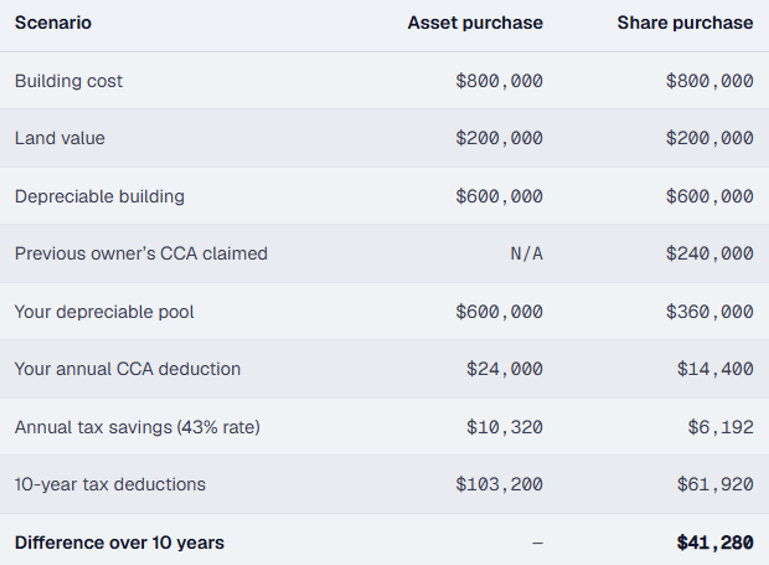
That $41,280 difference is real money—lost tax deductions you could have claimed.
Why This Matters in Deal Selection
Most rental properties sell via asset purchase. But if you’re buying a corporation that owns real estate (share purchase), you need to ask:
Has the previous owner already claimed CCA on this building?
If yes, how much has the CCA pool been reduced?
What’s my remaining depreciable base?
Your accountant should calculate this before you make an offer. A share purchase of a heavily depreciated property is worth significantly less than an asset purchase of the same building.
Many buyers don’t catch this until after closing. By then it’s too late.
Extracting Equity to Scale
Once you own property #1 and have built equity (through principal paydown and appreciation), your next move is extracting that equity to buy property #2.
There are three main methods:
Method 1: Refinance the Property
You refinance at a higher amount (based on the property’s new value) and take out the equity as cash.
Original purchase: $800,000
Original mortgage: $600,000 (75% LTV)
Current appraised value: $1,100,000
New refinance at 75% LTV: $825,000
Cash extracted: $225,000
This becomes your down payment on property #2.
Advantage: Clean separation. Property #1 keeps its original mortgage.
Disadvantage: You’re taking on additional debt and restarting the amortization clock.
Method 2: HELOC Against Primary Residence
A HELOC against your home equity is often cheaper than a mortgage.
Key advantage: The interest is tax-deductible when used to finance a rental property that generates income.
This is the Smith Maneuver—using borrowed money to invest, so the interest becomes a business expense.
Method 3: Return of Capital
If the rental property is held in a corporation, you can extract equity as a “return of capital” to yourself as the shareholder.
This has favorable tax treatment because it’s not taxed as income—it’s a return of your own capital.
Catch: CRA scrutinizes this closely. You need to be paying down debt or have a clear reason for the withdrawal.
The Wealth-Building Flywheel
Understanding CCA depreciation + share-sale trap + equity extraction, the full picture becomes:
Buy property #1 with disciplined pricing (DCF analysis)
Claim CCA depreciation annually (~$24,000/year)
Build equity through principal paydown + appreciation
Refinance into that equity ($225,000 cash)
Use HELOC (tax-deductible interest) or refinance cash as down payment on property #2
Repeat for property #3, #4, etc.
Each iteration amplifies:
Tax deductions (CCA compounds across properties)
Equity extraction (refinance cycles let you lever up)
Leverage (the bank’s money scales faster than your capital)
But only if you:
Priced deals correctly
Managed tax infrastructure
Avoided the share-sale trap
Financial Planning at Scale
When you’re managing 2–3 rental properties alongside salaried income, the financial picture becomes complex:
Multiple CCA pools (one per property)
Multiple HST schedules
Potential corporate structures (holding company)
Spousal income-splitting opportunities
Estate planning implications
This is where financial planning software becomes critical—not to tell you what to do, but to show you the full picture and model different scenarios.
The Deep Dive
I published a complete breakdown of CCA depreciation, the share-sale trap, equity extraction methods, and how to scale a rental portfolio strategically.
→ Read the full article: CCA Depreciation & Share-Sale Trap
The article covers:
How CCA works and your annual tax savings
The recapture issue and what it means at exit
Why share purchases cost you tens of thousands
Three equity extraction methods (refinance, HELOC, return of capital)
The wealth-building flywheel at scale
Financial planning when managing multiple properties
Why This Matters Before You Buy
The depreciation trap isn’t obvious until you’re three years in and you’ve already missed the optimization window.
Ask the right questions before you make an offer:
Is this an asset purchase or share purchase?
If share purchase, how much CCA has already been claimed?
What’s my depreciable pool?
Your lawyer and accountant should be answering these questions. If they’re not asking, you’re missing critical deal economics.
The same financial modeling that works for individual deals works for your entire portfolio and financial picture.
Sent from Halifax. Every Thursday to your inbox.