


A mortgage broker told me recently that switching lenders at renewal usually isn’t worth it, because the cost of moving wipes out the savings. He also said what people really need is advice based on their whole financial position.
He’s right about the second part. The first part is a number, so I checked it.
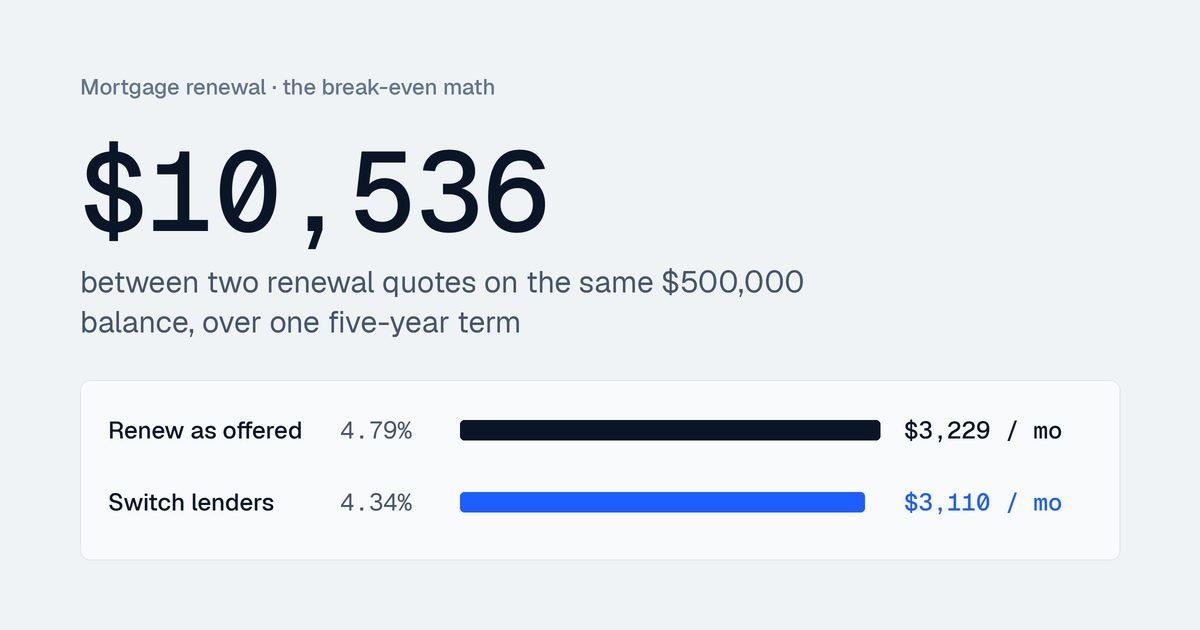
The example. A fictional family with $500,000 owing and twenty years left. Their renewal letter offers 4.79% for five years. A broker quotes 4.34%.
The monthly payment drops by about $119.
Over the five-year term they pay $7,159 less and owe $3,377 less at the end: $10,536 in total.
If they paid $1,500 in switching costs themselves, the $119 a month earns that back in 13 months.
Why the costs are smaller than people think. The big penalties people fear, three months’ interest or the interest rate differential, apply when you break a mortgage before the term ends. At renewal the term is over. What’s left are setup costs like discharge, appraisal and legal fees, and some lenders cover them. And since November 2024, a straight switch of an uninsured mortgage between federally regulated lenders no longer requires the stress test.
The part a rate comparison doesn’t show. The $119 has to go somewhere. Invested monthly for twenty years at 3.4%, it grows to about $40,900 by 65. This family puts $2,500 a year into their child’s education savings; sixteen years of that is $40,000. One renewal decision is worth about the same as every dollar they’ll personally put into that account.
There’s an honest wrinkle: at a 3.4% return and a 4.34% mortgage, putting the $119 against the mortgage would come out ahead of investing it. The point isn’t where it goes. It’s that the saving only exists if it lands somewhere on purpose.
When switching isn’t worth it: small balances, few years left, very small rate gaps, adding money or amortization, or a collateral charge that costs more to move. And sometimes your current lender simply matches the quote.
→ The full breakdown, with a break-even calculator for your own numbers
If you’d rather have it done for your household, with your options priced, the ten-year effect, and a one-page summary for your partner, here’s what that looks like.
Andrew Gannon, CFA
This is educational, not advice. YouGotThis doesn’t quote rates, recommend lenders or arrange mortgages, and no lender or broker pays us. Any decision about a mortgage rests with you and your licensed mortgage professional. Figures are illustrative and depend on qualification.