


I’m a big believer in crunching the numbers and picking the option that comes out ahead in black and white. My wife has wanted to pay down the mortgage faster for a different reason: she hates debt. Every time she opens our online banking and sees the balance, it gives her anxiety.
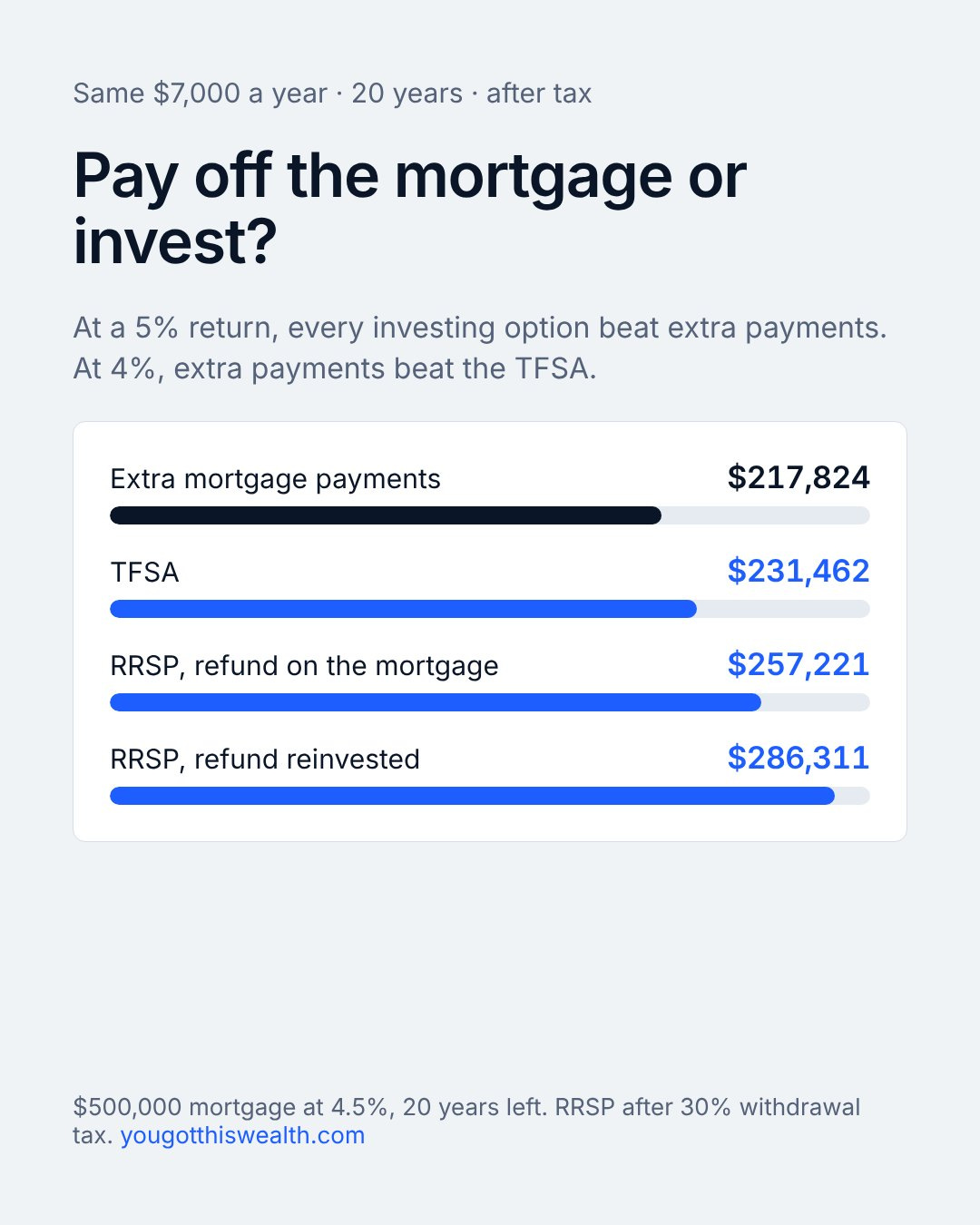
So I did what I do. I ran the same $7,000 a year four ways over 20 years, on a $500,000 mortgage at 4.5% with a 5% return, and compared what each leaves after tax:
- **Extra mortgage payments:** $217,824, mortgage gone in year 16
- **TFSA:** $231,462
- **RRSP, refund put on the mortgage:** $257,221
- **RRSP, refund reinvested:** $286,311
Every option spends exactly the same money. The differences come from three things:
1. **Your mortgage rate against your return.** An extra payment earns your mortgage rate, guaranteed and tax-free. At a 5% return the TFSA wins; at 4%, extra payments do.
2. **The RRSP’s two tax rates.** The refund comes in at 43%, and the money comes out at 30%. Make those equal and the RRSP lands exactly where the TFSA does.
3. **Whether the refund gets invested.** Spend it, and the RRSP drops to about $162,000, last of the four.
And then there’s the part no spreadsheet captures. After talking it through, we decided a couple of years of prepayments is worth it if it makes life easier at home. Behaviour matters as much as the model.
The full post covers:
- The four options in plain words, with every term defined
- A calculator for your own mortgage, rate and return
- What happens at 3%, 4% and 5% returns
- The five cases where paying down the mortgage comes out ahead
Run your own numbers → https://yougotthiswealth.com/blog/pay-off-mortgage-or-invest-canada/?utm_source=substack&utm_medium=email&utm_campaign=blog_pay-off-mortgage-or-invest-canada
General information, not financial advice.