


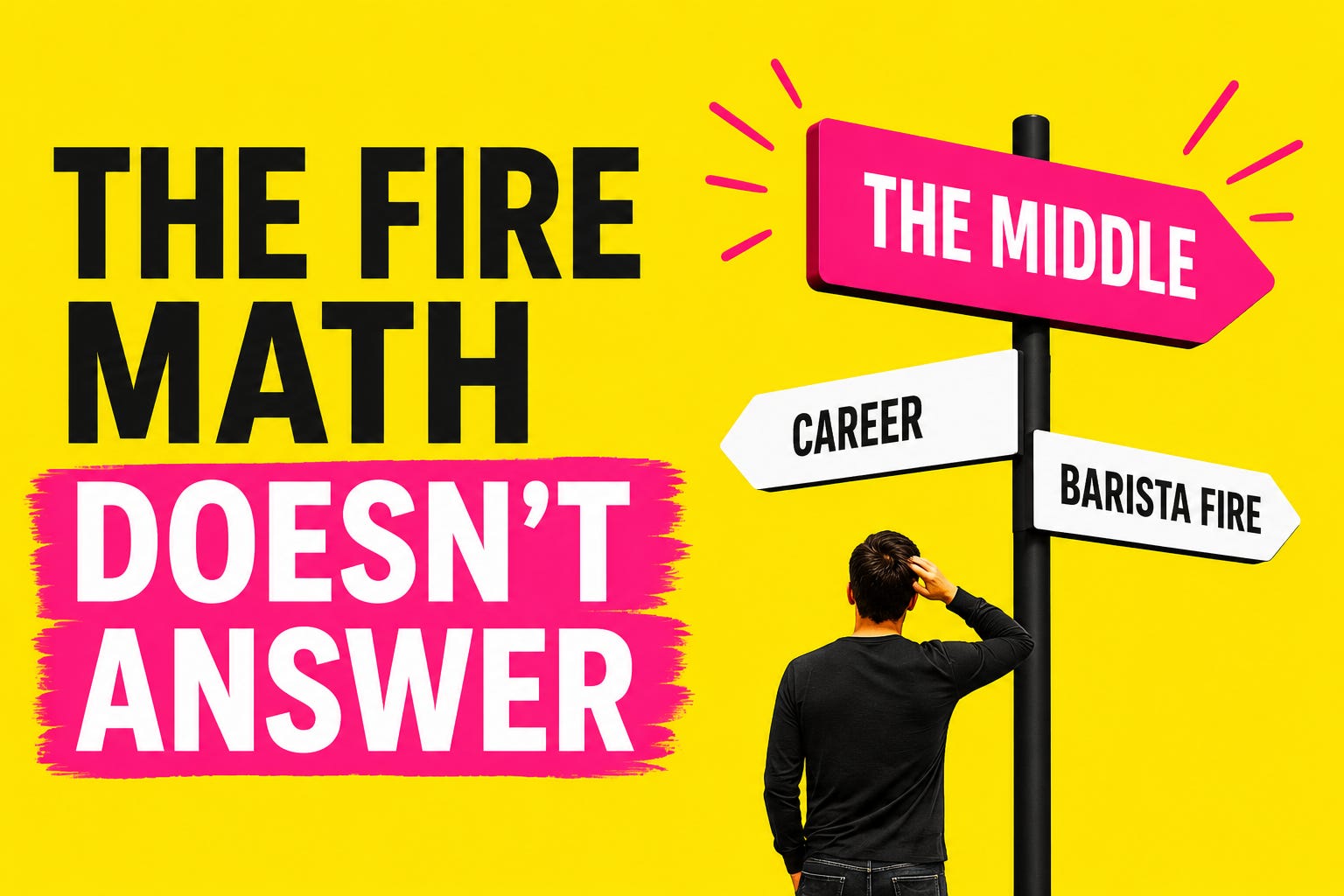
There’s a version of the retirement conversation that plays out on the personal finance forums every week. Someone hits their number, announces they’re quitting their career job to pour lattes or some other pejoratively described job. The opinions on this are split down the middle — half call it the dream, half say it’s not all it’s cracked up to be.
I think both camps are missing the point.
“Barista FIRE” treats the decision as binary: grind at the career until 65, or step all the way down to low-skill work because it looks less stressful from the outside. I don’t weigh in on that part, but between those poles is an enormous middle almost nobody mentions or runs the numbers on: consulting at a fraction of the hours, a board seat, a small local business, teaching, or caregiving. None of it is retirement in the gold-watch sense, but all of it produces a little income.
And income, it turns out, is the part the math cares about.
At the returns we’ve used through this series, every reliable dollar of lasting annual income is worth about $19.60 of portfolio you don’t have to build. That’s not a rounding error, that multiplier is fundamental to the whole game. And it’s especially the game in Canada, because CPP and OAS are a lasting, inflation-linked income stream. Between them, roughly $24,000 a year in government support quietly does the work of about $473,000 of savings. The American rules of thumb don’t account for that, because Americans don’t have our benefits.
For the household we’ve followed all series: funding every dollar yourself would take about $2.2 million; CPP and OAS bring it to about $1.73 million; and $40,000 a year of work you’d happily do anyway, for the first ten years, brings it to about $1.39 million.
So the financial independence number isn’t the price of stopping. It’s the price of one specific choice: never earning another dollar. Lower that bar even slightly, by staying engaged in something you’d choose regardless, and the number comes down to meet you.
What that something is, of course, is the part no spreadsheet answers. Mine involves coffee, capital markets, a golf course, and maybe a surfboard. Yours will look nothing like it. But that’s the luxury the number buys…it can be never working again if you want to, but really it’s the freedom to be choosy about it.
That’s the last piece of the series. Same math as the earlier parts, pointed at a better question.
See what your own number looks like → app.yougotthiswealth.com
See the full blog here → https://www.yougotthiswealth.com/blog/part-5-what-to-do-after-fire/